When people search "OT security vs IT security," most land on articles about factories, PLCs, and SCADA systems. That's not what your business needs. For a small or mid-sized business running office networks, cloud apps, and remote employees, the real comparison isn't IT versus OT at all. It's figuring out which managed security model fits: an MSP, an MSSP, a vCISO, or some combination. Our recommendation for most SMBs is an MSP with built-in MSSP functions, identity-first controls, and EDR as the baseline, adding a vCISO once compliance or cyber insurance requirements enter the picture. We recommend a provider that builds exactly this stack.
TL;DR:
- Most SMBs should seek a managed service provider that combines MSP, MSSP, and vCISO functions into a single stack, starting with identity-first controls and EDR.
- Baseline security controls must include multifactor authentication, tested backups, managed firewalls with segmentation, and 24/7 monitoring with documented incident response plans.
- Request live evidence of backup restores, audit log samples, and SLA details during provider assessments to ensure controls are operational before signing.
- Beware of providers with vague pricing, limited monitoring hours, or inability to produce proof of backup restores or incident responses on demand.
- Pricing for managed security typically runs on a per-user monthly fee, with higher-tier SOC services available as an upgrade for regulated or sensitive industries.
Table of Contents
- OT Security vs IT Security: MSP, MSSP, and vCISO Explained
- Core IT Security Controls Every SMB Should Require
- How to Evaluate and Shortlist a Security Provider
- How We Build Managed Security for SMBs
- Get a Managed Security Stack Built to This Checklist
- Sources
- FAQ
OT Security vs IT Security: MSP, MSSP, and vCISO Explained
Before you shop for a provider, you need to know what each role actually does. This is the real "OT vs IT security" question for a business like yours: not industrial control systems, but operational IT support versus dedicated security operations versus strategic governance.
An MSP (managed service provider) runs your day-to-day IT out of a network operations center, or NOC. Think helpdesk tickets, patch management, backups, and keeping printers and servers alive.
An MSSP (managed security service provider) operates from a security operations center, or SOC, and focuses on detecting and stopping threats. That means 24/7 monitoring, endpoint detection and response (EDR), incident response, and compliance reporting.
A vCISO (virtual chief information security officer) doesn't run daily operations at all. A vCISO sets strategy, builds governance frameworks, and prepares your business for audits or cyber insurance renewals. According to Securafy's breakdown of the three roles, a vCISO without an operational partner to execute 24/7 monitoring and incident response is an incomplete solution on its own.
Here's how that plays out by business profile:
- Micro-business (under 15 employees): An MSP with basic MSSP-style protections, MFA, and EDR usually covers the risk without the cost of a full SOC.
- Growth-stage SMB (15 to 75 employees): A combined MSP/MSSP model, with 24/7 monitoring and managed firewall, becomes worth the investment as attack surface grows.
- Regulated or data-sensitive SMB (finance, healthcare, legal): Add a vCISO for governance, documented compliance evidence, and audit prep on top of MSSP-grade monitoring.
- Manufacturer with actual OT concerns: Keep IT and OT strategies separate. If you run PLCs or plant floor systems, that's a different conversation. Read our guide to industrial IoT security for that side of the business, and keep this framework for your office network and business systems.
Most SMBs land in the first two categories. That's good news: it means the fix is usually a single provider, not three separate contracts.
Core IT Security Controls Every SMB Should Require
Whichever model you pick, certain controls aren't optional anymore. These are the baseline items a provider should already have running before you sign anything.
- Identity and conditional access. Multi factor authentication, conditional access policies, and privileged account restrictions stop the majority of lateral movement inside a compromised network. Identity-first security is often the single most cost-effective control an SMB can add, since most breaches spread through stolen or reused credentials, not exotic malware.
- Endpoint detection and response (EDR). EDR should do more than flag a suspicious file. It needs to isolate an infected device remotely, walk your team through containment, and hand you a clear record of what happened and when.
- Managed firewall and network segmentation. A firewall that nobody actively tunes is just a box. Pair it with segmentation so a compromised laptop in accounting can't reach your finance server or your production database.
- Backups with tested restores. A backup you've never restored is a hope, not a plan. Ask when the last full restore test happened and what the recovery time actually was.
- 24/7 monitoring and documentation. Threats don't stop at 5 p.m. Neither should your monitoring. Documented incident response plans and audit logs also matter more than most owners realize: SecurityMetrics notes that audit-ready compliance evidence is one of the things SMBs most often lack until an insurer or regulator asks for it.
Pro Tip: Ask your current provider to show you, live, the last time they restored a backup successfully. If they can't produce that in under five minutes, you don't actually have a tested backup plan. You have a folder of files and an assumption.
How to Evaluate and Shortlist a Security Provider
A vendor call should feel like an interview, not a sales pitch. Come with specific questions and expect specific answers.
Ask providers directly:
- Do you operate a SOC, or is monitoring handled during business hours only?
- What does EDR coverage include, and who responds when it triggers an alert?
- How are identity and conditional access policies enforced, not just recommended?
- Can you show me proof of a recent, successful backup restore test?
- What compliance documentation do you generate, and is it audit-ready?
- Who is my named contact, and what's the SLA if something breaks at 2 a.m.?
Red flags worth walking away from: vague or bundled pricing with no line items, monitoring that only runs 9 to 5, no documented incident response process, and any provider who can't produce a real restore log on request. SecurityMetrics found that assuming basic backups and antivirus are "good enough" is one of the most common and costly mistakes small businesses make.
On pricing, expect managed security for small businesses to run on a per-user monthly model rather than hourly billing. Wintive's research on small business managed security pricing notes that core protections, identity, backup, monitoring, and compliance basics, are usually included in a base tier, with full SOC-level services offered as an upgrade rather than a default. If you already run internal IT staff, ask about co-managed pricing instead of paying for a full stack twice.
Book a 30 to 45 minute assessment call and expect real deliverables afterward: a documented risk summary, a sample incident response outline, and a plain-English explanation of gaps found, not just a slide deck.
How We Build Managed Security for SMBs
Most vendor conversations focus on features. We think the better question is whether a provider will actually show up when something breaks, and whether they can prove their controls work before you ever need them.
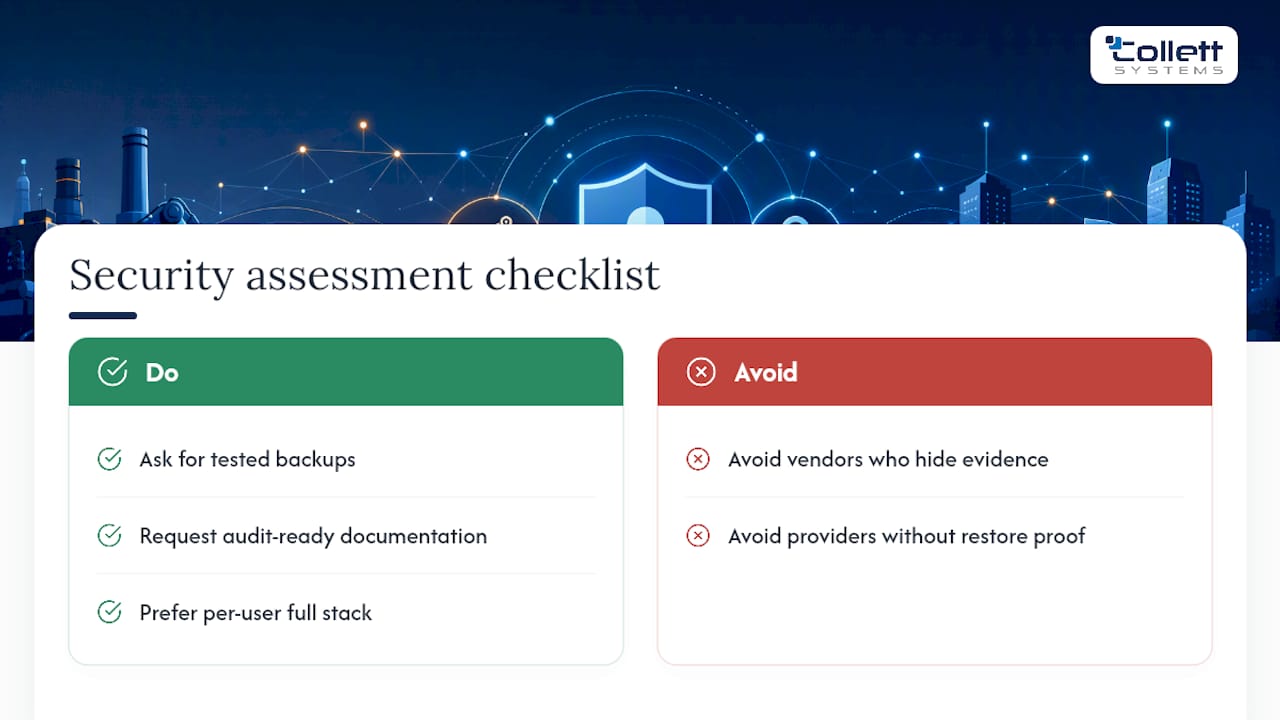
Some providers standardize on a fixed per-user, fully-loaded stack: identity-first controls, EDR, managed firewall, and 24/7 monitoring, for every client, not just those who pay for a premium tier.
If you want to see what tested backups and audit-ready documentation actually look like before committing to anyone, ask for it during an assessment. A provider who hesitates to show you a restore log or an incident summary is telling you something.
, Dustin Collett
Get a Managed Security Stack Built to This Checklist
Everything covered above, identity-first access, EDR, managed firewall, 24/7 monitoring, and tested backups, is exactly what some providers include as standard, often for one fixed per-user price without tiered upsells.
An initial assessment with our team surfaces the same evidence you'd ask any provider for: a live look at backup restore capability, sample audit logs, and a named escalation contact with a real response SLA, not a call center queue. If you run a growth-stage business that needs the full combination, or a very small team better suited to a lighter footprint, we'll tell you honestly which fits. Start with our Small Business IT Support Services page, or if you already run internal IT staff, look at our co-managed IT services option instead.
Sources
- Managed Security Services for Small Business 2026 | Wintive
- MSP vs MSSP vs vCISO, Securafy blog
- The 7 most common mistakes in small business security, SecurityMetrics
FAQ
Is "OT Security vs IT Security" Relevant to a Typical Small Business?
Not directly. Unless you operate industrial control systems or plant floor equipment, the phrase for your business really means choosing between MSP, MSSP, and vCISO models for network and endpoint security.
What's the Difference Between an MSP and an MSSP?
An MSP keeps your systems running day to day from a NOC, handling things like helpdesk and patching. An MSSP runs a SOC focused specifically on threat detection, EDR, and incident response.
Do I Need a vCISO if I Already Have an MSSP?
Only if you face compliance requirements, cyber insurance audits, or need formal governance and risk documentation; a vCISO adds strategy on top of the operational monitoring an MSSP already provides.
How Much Should Managed Security Cost for a Small Business?
Most providers price managed security per user per month, with core protections like identity, backup, and monitoring included in the base tier and full SOC-level service offered as an upgrade.
What Should I Ask a Provider Before Signing a Contract?
Ask whether they run a real SOC, what EDR coverage includes, whether they can prove a recent successful backup restore, and who your named escalation contact is during an incident.
Does a provider offer this as one combined service?
Some offer identity-first controls, EDR, managed firewall, and 24/7 monitoring in a single fixed per-user stack, rather than splitting them across separate contracts or pricing tiers.